
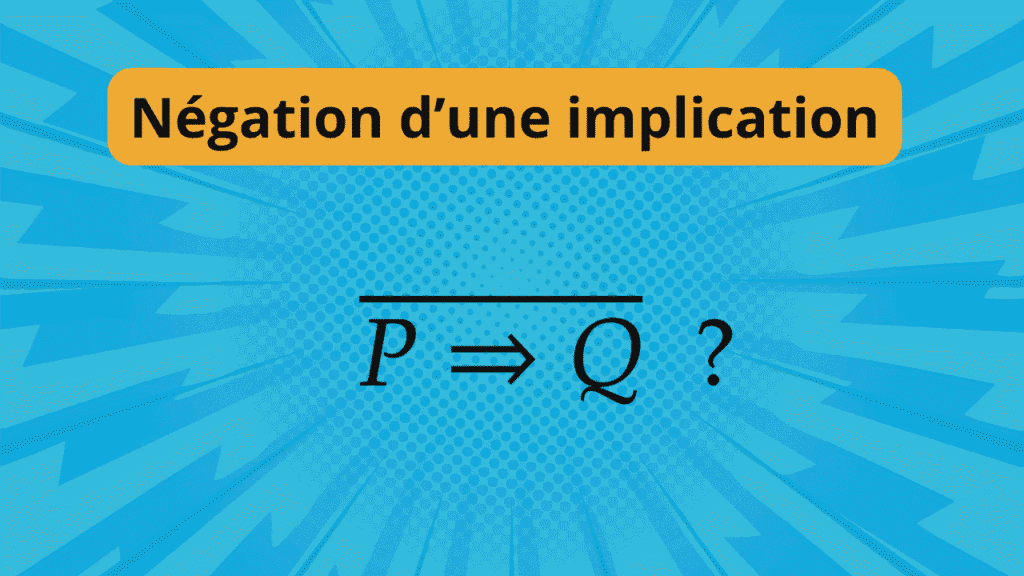
Dans ce cours, nous présenterons la méthode permettant de formuler la négation d’une implication en logique mathématique, ainsi que des exemples illustrant l’application de cette méthode à la négation de P implique Q.
1) Négation de \(P \Rightarrow Q\)
On sait que les propositions \( « P \Rightarrow Q » \) et \( «\overline{P} \ \text{ou} \ Q » \) sont logiquement équivalentes, où \(\overline{P} \) désigne la négation de la proposition \(P\).
Ainsi, la négation de \( «P \Rightarrow Q » \) n’est autre que la négation de \( «\overline{P} \ \text{ou} \ Q » \)
Or, par les lois de de Morgan, \( «\overline{\overline{P} \ \text{ou} \ Q } » \) est logiquement équivalente à \( «P \ \text{et} \ \overline{Q} » \).
Ainsi, la négation d’une implication \( « P \Rightarrow Q » \) n’est autre que \( «P \ \text{et} \ \overline{Q} » \).
2) Exemples de négation d'implications
\(
\begin{array}{|l|l|}
\hline
\textbf{Proposition} & \textbf{Sa négation} \\
\hline
\sqrt{2} \in \mathbb{Q} \Rightarrow 3 \in \mathbb{Z} & \sqrt{2} \in \mathbb{Q} \ \text{et}\ 3 \notin \mathbb{Z} \\
\hline
4 \ \text{est un carré parfait} \Rightarrow \mathbb{N} \subset \mathbb{R} & 4 \ \text{est un carré parfait et } \mathbb{N} \not\subset \mathbb{R} \\
\hline
\forall x>0,\ x \in \mathbb{Z} \Rightarrow x \in \mathbb{N} & \exists x>0,\ x \in \mathbb{Z} \ \text{et}\ x \notin \mathbb{N} \\
\hline
\forall x \in \mathbb{R},\ x^{2}=1 \Rightarrow (x=1 \ \text{ou}\ x=-1) & \exists x \in \mathbb{R},\ x^{2}=1 \ \text{et}\ (x \neq 1 \ \text{et}\ x \neq -1) \\
\hline
\forall x \in \mathbb{R}, \forall n>0,\ |x|<n \Rightarrow x=0 & \exists x \in \mathbb{R}, \exists n>0,\ |x|<n \text{ et } x \neq 0 \\
\hline
\end{array}
\)